


1. Equipment Features
- Airflow atomization spray with small spray angle, preventing wall collision;
- Drying achieves fine powder with particle sizes of 1-8 microns;
- Particle size distribution is steep and relatively uniform;
- Particle size is adjustable;
- Wider applicability to materials;
- The entire atomization structure contains no plastic gaskets or motors, resulting in longer service life and easier maintenance;
- Upgradable to a diamond-coated atomization structure, compatible with various metal materials;
- The atomization structure is easy to disassemble, clean, and maintain;
2. Equipment Advantages
- The atomization system adopts an innovative airflow atomization structure featuring a dual-orifice asymmetrical design, enabling a two-stage atomization process with excellent droplet uniformity. The powder particle size can be adjusted by modifying relevant parameters based on the two-dimensional curve chart of the QFN-CX-NZY8-075VER2018-1A atomization system.
- The nozzle of the atomization system is coated with diamond, offering significantly higher wear resistance compared to standard SUS304 material, with a service life over 10 times longer.
- Upgradable to a low-temperature spray dryer (equipped with Qiaofeng's low-temperature drying system QFN-CX-5-MD10), enabling spray drying of materials at temperatures as low as 35°C. This is significant for the development of new materials. It allows spray drying across a wide temperature range of 35–280°C, functioning as a high- and low-temperature integrated spray dryer, distinguishing it from conventional high-temperature spray dryers operating at 180–280°C.
- Particle size analysis (data sourced from customers):


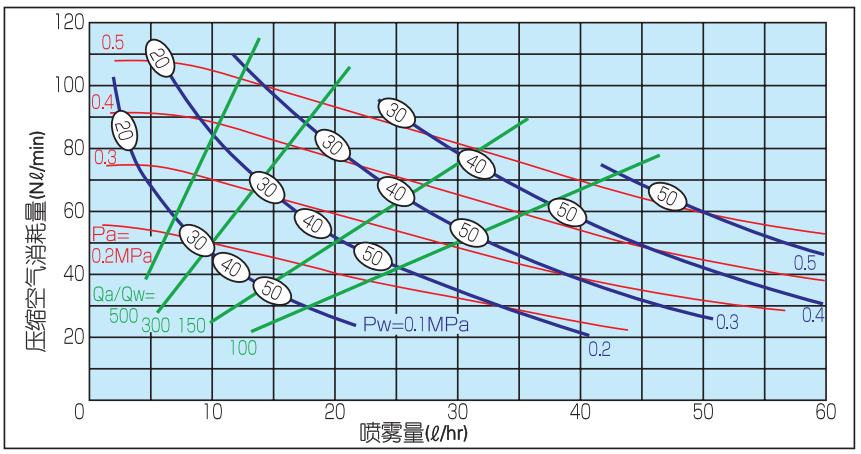
3. Two-Dimensional Curve Chart of the QFN-PWCX-NZY8VER2018-075A Atomization System
How to Read the Curve Chart
1 indicates the spray rate per nozzle (l/hr)
2 The red line represents compressed air pressure PA (MPa), the blue line represents liquid pressure PW (MPa), and the green line represents the air-to-liquid ratio QA/QW.
3. The numbers inside indicate the SAUTER mean diameter (microns) measured by the Topler method.
How to Read the Curve Chart
1 indicates the spray rate per nozzle (l/hr)
2 The red line represents compressed air pressure PA (MPa), the blue line represents liquid pressure PW (MPa), and the green line represents the air-to-liquid ratio QA/QW.
4. 
 The numbers inside indicate the SAUTER mean diameter (microns) measured by the Topler method.
QFN-CX-NZY8VER2018-075A Atomization System:

Example: If the average dry powder particle size is approximately 3 microns, and the solid content of the feed solution is 10% (1/10),

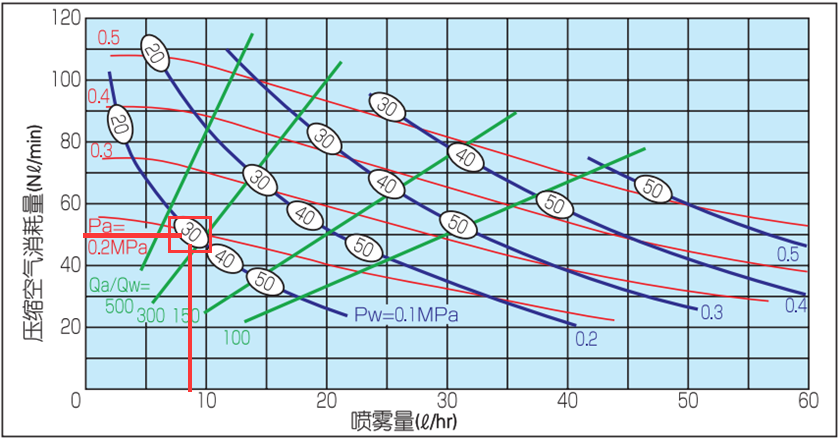
then the required average wet droplet size is 3/0.1 = 30 microns. With a feed rate of approximately 8 L/hr and compressed air at 0.2 MPa, the intersection point is approximately 30 microns.
For other droplet sizes, first determine the processing capacity, draw a vertical axis to find the approximate particle size, then locate the intersection point to determine the compressed air pressure.
Note: Considering the influence of material density, viscosity, and other parameters on droplet size, the deviation is ±△3. The average particle size should be within 30 ± △3, i.e., [27, 33].