


Which small spray dryer is the best choice? In the fields of food, pharmaceuticals, fine chemicals, and new materials research and development,Small Spray Dryerit has become core equipment in laboratories and pilot plants. It can convert liquid slurry into free-flowing dry powder in a single step, significantly shortening formulation development cycles. However, faced with dozens of brands and various configurations on the market, procurement personnel often fall into the confusion of “Which Small Spray Dryer Is Best” which one is good. The following will not simply list brands, but will deconstruct the hardware, control, and process adaptability that affect performance from an engineering perspective, helping you establish a quantifiable supplier evaluation framework, so that “good” is no longer a subjective impression but a verifiable technical fact.
Technical Principles and Industry Status
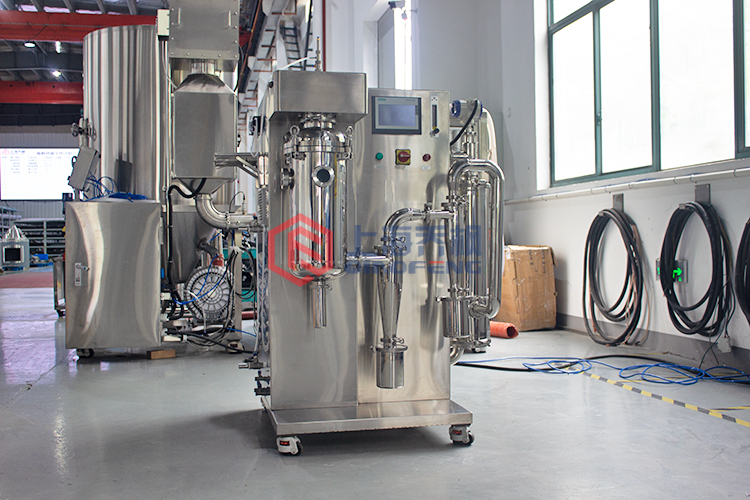
The core of spray drying lies in dispersing liquid material into micron-sized droplets through an atomizer, causing the surface moisture to evaporate instantly in high-temperature hot air, forming dry powder particles.Small Spray DryerTypically designed for laboratory batch processing capacities (commonly 0.5L to 5L/h water evaporation rate), its atomization methods are mainly divided intotwo-fluid nozzles和and centrifugal atomization discs. The former uses high-speed compressed air jets to shear the liquid film, suitable for processing high-viscosity or solid-containing slurries; the latter uses a high-speed rotating disc to fling the material into droplets, resulting in powder with a narrower particle size distribution and better sphericity, but maintenance is slightly more complex.
According to industry research, the domestic small spray dryer market has maintained a compound annual growth rate of approximately 12% in recent years. Domestic equipment has rapidly improved in control systems and overall machine sealing, now capable of covering most closed-loop system requirements for organic solvents. However, in the preparation of ultra-fine microcapsules (particle size < 5μm) and explosion-proof design details, some foreign brands deeply rooted in this field still possess long-accumulated process databases, which is precisely the hidden dividing line distinguishing “good” from “bad” suppliers.
How to Evaluate “Which One is Good”: Five Diagnostic Dimensions
1. Hardware Configuration and Process Adjustability
An excellent small spray dryer should have key components withwide-range adjustment capabilities. When evaluating, please pay attention to:
- Nozzle/Atomization Head: Are nozzle kits with different orifice sizes provided? Can it handle suspensions with solid content of 10% to 30% without clogging? The impact of nozzle selection on particle morphology.
- Heating System: The inlet air temperature should be continuously adjustable, typically between 150°C and 250°C, with high-precision PID control deviation controlled within ±1°C to avoid denaturation of heat-sensitive materials.
- Powder Collection Method: A cyclone separator is standard, but can the collection rate reach over 85%? Can electrostatic capture or a bag filter be added to further improve fine powder recovery?
- Glass Components and Stainless Steel Piping: A transparent borosilicate glass drying chamber facilitates observation of the atomization state, but if processing organic solvents, it must be switched to a fully stainless steel closed-loop system with inert gas protection.
2. Material and Compliance Verification
For all parts contacting the material, including the peristaltic pump tube, spray head gaskets, and collection bottles, the material declarations should be written into the contract appendix. Food and pharmaceutical grade applications require316L stainless steel, PTFE, or silicone materials compliant with FDA/EU standards, with surface polished to Ra ≤ 0.8μm to reduce wall adhesion. Users can request suppliers to providematerial certificates和and roughness inspection reports, which serve as a professional benchmark to judge whether the manufacturer will take small and medium-sized clients seriously.
3. Control System and Data Integrity
Modern laboratories increasingly value data traceability. Good suppliers will providecolor touch screens with PLC control, recording parameters such as inlet/outlet air temperature, peristaltic pump speed, airflow rate, and atomization pressure in real-time, and can export CSV or PDF experimental batch reports. Some intelligent models even have built-inprocess recipe librariesfor common materials (e.g., milk, traditional Chinese medicine extract, ceramic slurry), allowing users to call and fine-tune with one click, reducing the probability of operational errors by novices. During evaluation, request a remote online demonstration of the actual software interface to check if historical data curves are smooth and without gaps.
4. Trial Service and Process Support Capability
Judging “which small spray dryer is the best,” the trial run is the touchstone. Responsible manufacturers will suggest you bring your own material liquid to their lab for afree trial drying, and based on the powder's moisture content, particle size, and SEM morphology, output aprocess reportcontaining recommended parameters and collection rate. This tests not only the equipment but also the application engineer's process understanding. If a manufacturer refuses a trial run or only allows the use of their specified materials, it usually indicates insufficient experience with difficult-to-spray materials.
5. After-Sales Response and Spare Parts Supply
Niche brands often face the dilemma of “affordable to buy but expensive to repair.” Please confirm: Are common wear parts (seals, nozzles, high-temperature filters) standard components? What is the delivery lead time? Is remote diagnosis within 24 hours provided? It is understood that manufacturers with a comprehensive domestic service system can ensure continuous supply of core components for 5 years and provide an annual on-site inspection service during the warranty period. It is recommended to explicitly stipulate these terms in the procurement contract.
Practical Applications and Operational Recommendations
To avoid selection errors, procurement personnel can follow this process:
- Fill out a Material Information Form: Fully disclose to the supplier the material's solid content, viscosity, solvent type (water/ethanol/acetone), heat-sensitive temperature, target particle size range, etc., and sign a confidentiality agreement.
- Request Similar Case Studies: Obtain at least 3 drying curves or SEM comparison images for materials similar to yours (non-confidential) to indirectly verify experience accumulation.
- On-Site Witness with Material: Observe throughout whether atomization is uniform, if there is wall adhesion, if the collection rate meets expectations, and test the residual moisture of the powder on-site. Also, pay attention to the ease of cleaning after shutdown—excellent structural design should allow fortool-free quick disassembly and assembly。
- .Compare Total Lifecycle Cost
: Do not only focus on the purchase price, but also consider the replacement frequency and unit price of wear parts, energy consumption, and the integration cost with subsequent pilot-scale equipment.
Frequently Asked Questions (FAQ)
Q1: How much does a small spray dryer generally cost?
A: The price range is wide. A basic aqueous solution glass model typically ranges from RMB 30,000 to 120,000; an organic solvent-resistant stainless steel closed-loop model usually ranges from RMB 150,000 to 350,000. If explosion-proof certification and low-temperature condensation recovery are involved, the cost will be higher. It is recommended to configure based on actual process requirements to avoid paying a premium for unused features.
Q2: Why is my powder collection rate always below 60%?
A: Common reasons include: mismatch between cyclone separator specifications and particle size, particles being too fine (< 2μm) and escaping with exhaust gas, high material viscosity causing adhesion to the drying chamber wall, or clogging of the outlet filter bag leading to airflow disruption. Try increasing the inlet air temperature, reducing the feed rate, or adding a secondary electrostatic capture device, and consult the supplier for adjustment solutions.
Q3: How to ensure safety when processing organic solvents?A: Aninert gas closed-loop system
Q4: What are the differences between imported brands and domestic brands?
A: High-end imported equipment has deeper accumulation in ultra-fine powder preparation process databases and extreme explosion-proof cases. However, in recent years, domestic brands have shown significant advantages in intelligence, ease of use, and delivery time, and there is no difference in drying performance for many conventional materials. It is recommended to replace “origin bias” with “trial results.”

Leave a Comment