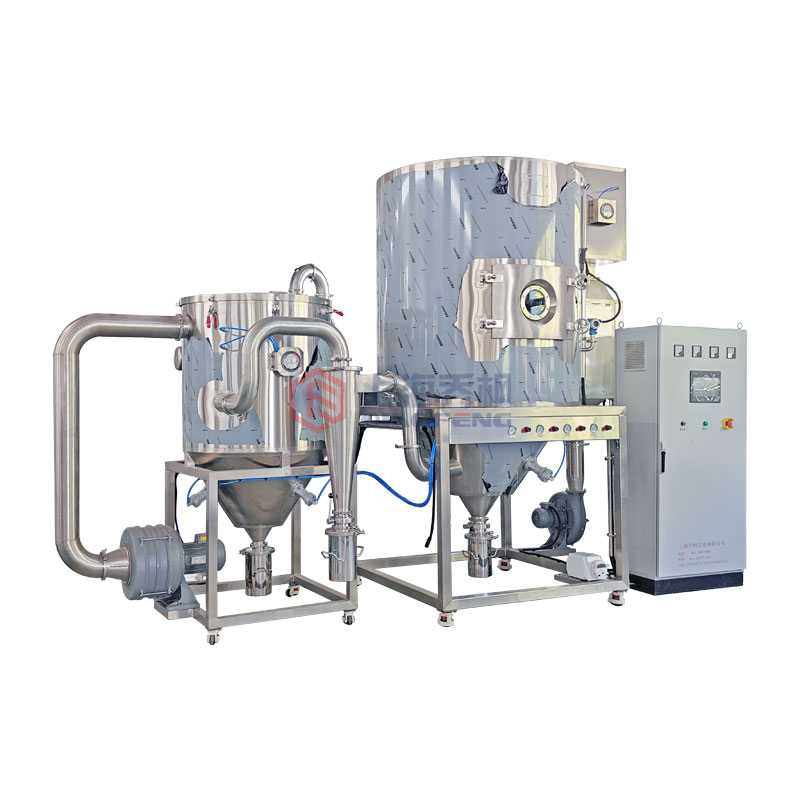
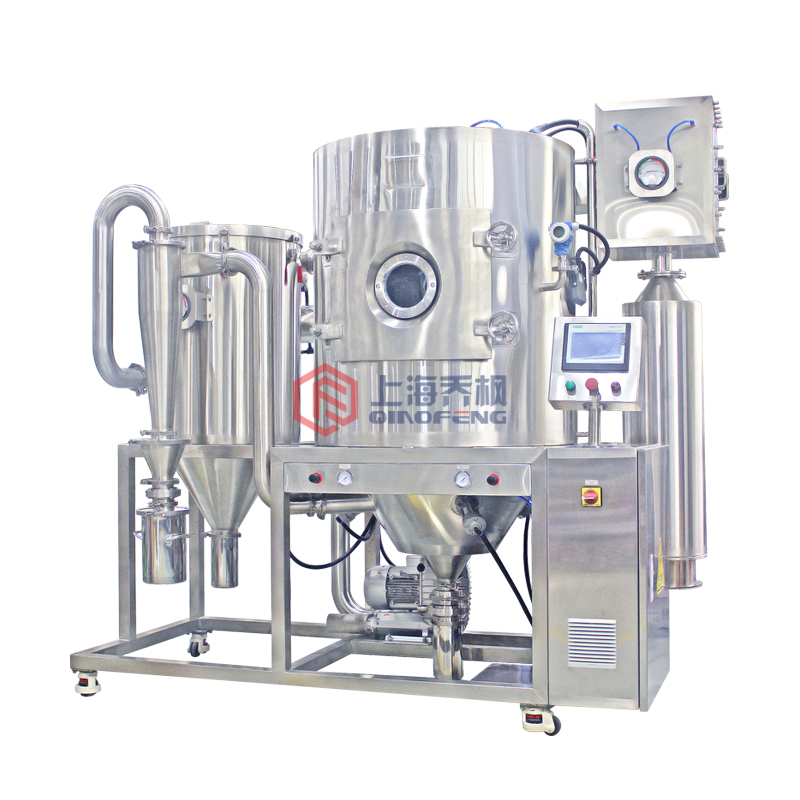
I.Centrifugal and Two-Fluid Dual-Purpose Spray DryerEquipment Introduction
This spray dryer consists of seven systems, namely the feed system, atomization system, drying tower, material recovery system, heating system, piping system, and control system.

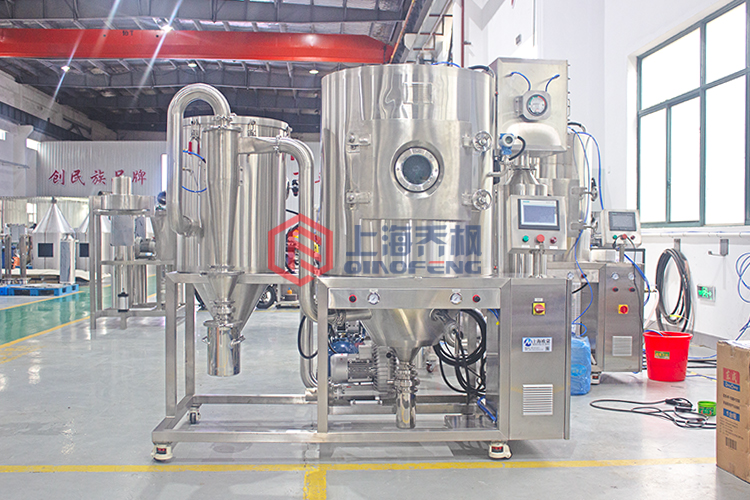
1. Equipment Principle Introduction
A spray dryer is a drying device used to process solutions, suspensions, or slurry-like materials. The basic process involves the feed liquid passing through an atomizer, forming droplets dispersed in a hot air stream. Air is sent by a blower into an air heater for preheating, then enters the spray dryer to contact and dry the droplets. A portion of the product falls to the bottom of the tower and is separated from the gas, while another portion is drawn by an induced draft fan into a cyclone separator, where separation occurs and the exhaust gas is discharged. A centrifugal spray dryer primarily utilizes the high-speed rotational force of a rotary atomizer to disperse droplets.
An airflow-type spray dryer is named for its use of a pneumatic atomizer. The working principle of the pneumatic atomizer is to utilize high-speed
airflow to cause the liquid film to split. The high-speed airflow uses compressed air. The flow rate of the feed liquid is very low. When the compressed air is discharged from the atomizer at a very high annular
gap velocity, a significant velocity difference exists between the two, generating friction and shear forces between the gas and liquid. The liquid is instantly drawn into fine, elongated filaments, which quickly break at thinner points to form tiny droplets.
A centrifugal spray dryer primarily utilizes the high-speed rotational force of a rotary atomizer to disperse droplets, which are likewise dried by hot air to become powder or granules.
This spray dryer is a dual-purpose model combining centrifugal and airflow atomization. When the experiment requires powder, the airflow type is adopted, which offers a long service life and is not easily damaged; this is also a drawback of the centrifugal atomizer. When the experiment requires uniform powder or granules, the centrifugal atomization system is selected for spray drying.
2. Overall Equipment Structure (subject to the supplier's final design)
3. Feed System
The feed system consists of a peristaltic pump and peristaltic pump tubing.
4. Atomization System
The atomization system adopts a centrifugal atomizer. The pump delivers the feed liquid into the atomizer, and the high-speed airflow discharged from the nozzle annular gap atomizes the feed liquid. The droplet size can be adjusted by changing the gas-liquid ratio.
5. Drying Tower
The drying tower mainly consists of the tower body, conical bottom, volute casing, gas distributor, and temperature sensors. The atomization radius, residence time, and processing air volume are designed based on the moisture evaporation rate and material properties. To prevent material splashing during collection,
the drying tower operates under slight negative pressure. The upper part of the drying tower is the hot air inlet, equipped with a volute casing and hot air distributor. Hot air is uniformly distributed through the hot air distributor, achieving uniform and effective heat exchange with the droplets, drying them into dry powder products. Temperature sensors are used to record the inlet air temperature and outlet air temperature.
6. Material Recovery System
The material recovery system consists of a cyclone separator and a bag filter. The dust-laden gas after drying enters the cyclone separator, where gas-solid separation is carried out through cyclonic action. The powder enters the collection barrel while the gas is discharged from the top outlet and enters the bag filter. Trace amounts of ultrafine powder in the gas are effectively recovered through the bag filtration method.
7. Heating System. The heating system consists of an air filter, a blower, and an explosion-proof electric heater.
8. Piping System. The piping system consists of an induced draft fan and stainless steel piping.
9. Control System. Centered on a programmable logic controller, it controls all critical functional devices and fault alarms, with both automatic and manual control modes available.
II.
Parameters of the Centrifugal and Two-Fluid Dual-Purpose Spray Dryer Unit:Tower inner diameter: Φ800mm
Ø Tower outer diameter: Φ1000mm
Ø Induced air volume: 600 m³/h
Ø Inlet air temperature: 110-250°C
Ø Outlet air temperature: 80-95°C
Ø Moisture evaporation rate: 5 kg/h (at 250°C)
Ø Solids content: Depends on material conditions
Ø Heat source: Electric heating
Ø Material collection method: Three-point collection via bag filter, tower bottom, and cyclone.
Ø Bag filter material: Toray (Japan), PTFE pleated filter cartridge
Ø Atomization method: A: Centrifugal (electric type, 24000 RPM, adjustable speed, atomizer controlled by variable frequency drive) B: Two-fluid airflow type (pneumatic atomization, air pressure adjustable to 0.2 MPa)
Ø Whether bag filter system is included: Included
I. Introduction to the Centrifugal and Two-Fluid Dual-Purpose Spray Dryer Equipment. This spray dryer consists of seven systems, namely the feed system, atomization system, drying tower, material recovery system, heating system, piping system, and control system. 1. Equipment...